Thanksgiving is just around the corner so my mind is on our dinner menu. The stakes are a bit higher this year, as we are hosting my son’s future in-laws, whom we will be meeting for the first time. They, like many people, eat a fairly traditional meal. And I, making Thanksgiving dinner for only the fourth or fifth time in my life, plan to make pretty standard fare – turkey, gravy, stuffing, mashed potatoes, sweet potatoes, Brussels sprouts, green salad, cranberry sauce, rolls, and three pies. Those of you who know me know that this is a big departure from my usual style. First, that’s an awful lot of carb dishes in one meal. Second, I am not incorporating a single ethnically-inspired dish. Thanksgiving is not a time to mess with people’s culinary expectations.
Maybe it’s the confluence of Thanksgiving, my husband’s birthday (which he shares with my late father), Veteran’s Day, and a suddenly uncertain world that got me thinking about food legacies and traditions. My German-born dad loved a cake called bienenstich, which means bee sting cake. It is filled with custard and has a caramelized almond topping. In the absence of bienenstich or readily accessible recipes when I was a kid, my dad adopted the very American Boston cream pie as a new favorite. On his birthday, Eric ate a Boston cream doughnut and I was reminded of my dad. My mom evokes memories of the rhubarb pie that we continue to share every time I visit, marble cake that she no longer makes, and a bar cookie we invented called a scrunchy. What is my legacy? I don’t know.
I alluded to the fact that my cooking style is multi-ethnic. It started long ago when my then-boyfriend and now-husband and I looked for common ground on Jewish holidays. We intersected at the corner of food and Jewish traditions around the world. Our tradition has evolved into hosting family and friends on the second nights of Pesach and Rosh Hashana for an exploration of Jewish holiday cuisine around the world. Each year, we pick a country that has been in the news (for Rosh Hashana) or whose Jewish population has a freedom story (for Pesach) and we cook the entire meal with that country’s recipes. We explored Cuban cuisine this past Pesach and Turkish on Rosh Hashana. I am notoriously unsentimental so I’ve kept no records of what I made, except in those years when Eric created a menu for our guests. I am not proud of that.
I assume my kids have warm memories of holiday meals but I have no idea what foods they remember from their childhood. They might think about my homemade challah, but Eric took that over years ago because he’s a much better braider. Maybe they remember the hodgepodge of culinary exploration that defines the way we eat not just on holidays but year-round. Maybe they remember eating lots of dishes with fruits and vegetables, always having a balanced meal, and rarely eating the same dish twice. But as far as associating me with a particular dish on the holidays, there’s not much there, except my gingerbread cake on Thanksgiving weekend.
Several years ago, one of my friends made the most delicious gingerbread from a Gramercy Tavern recipe. It is a dentist’s nightmare with its gobs of sugar and molasses, but it’s really tasty. I started making it a few years ago for Thanksgiving and now make it every year, whether we have dinner at home or not. Because it’s too soon for me to make it this year, I borrowed a photo posted by lunasea on GroupRecipes.com. For those who follow dietary laws, the cake is pareve. Try it – maybe it will become your tradition too.
And be sure to ogle this beautiful pumpkin pie in an article on Thanksgiving food memories that talks about my colleague Priscilla Martel.
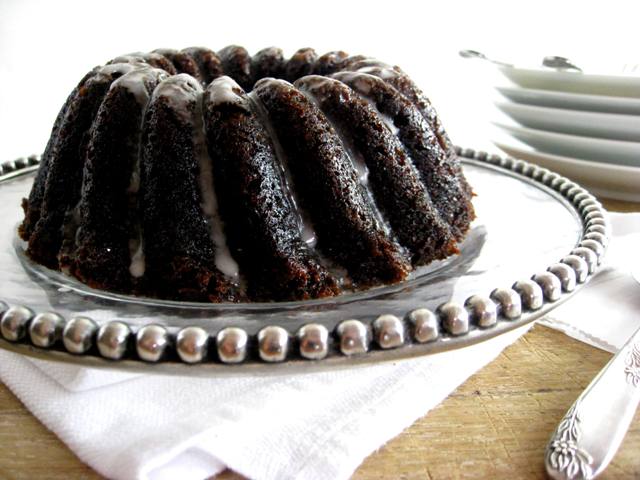
Gramercy Tavern Gingerbread Cake
Adapted by Epicurious.com
Serves up to 16
1 cup oatmeal stout or Guinness Stout
1 cup dark molasses (not blackstrap)
1/2 teaspoon baking soda
2 cups all-purpose flour
1 1/2 teaspoons baking powder
2 tablespoons ground ginger
1 teaspoon ground cinnamon
1/4 teaspoon ground cloves
1/4 teaspoon freshly grated nutmeg
Pinch of ground cardamom
3 large eggs
1 cup packed dark brown sugar
1 cup granulated sugar
3/4 cup vegetable oil
Confectioner’s sugar for dusting
Special equipment:
a 10-inch (10- to 12-cup) bundt pan
Directions
- Preheat the oven to 350°F. Generously coat a bundt or angel food cake pan with cooking spray and dust with flour, knocking out excess. (Mindy’s note – Be sure to coat well with flour on the sides and stem so that the cake comes out of the pan cleanly. If you use an angel food pan, cut a parchment ring to fit on the bottom of the pan, then coat and flour.)
- Bring the stout and molasses to a boil in a large saucepan and remove from heat. Whisk in baking soda, then cool to room temperature.
- Sift together flour, baking powder, and spices in a large bowl. (Mindy’s note – I am going to use McCormick’s new gingerbread spices this year.) Whisk together the eggs and sugars. Whisk in the oil, then molasses mixture. Add to the flour mixture and whisk until just combined. (Mindy’s note – I find that the batter takes a fair amount of whisking to incorporate all the flour and prevent flour pellets in the baked cake.)
- Pour batter into the prepared pan and rap pan sharply on counter to eliminate air bubbles. Bake in the middle of oven until a tester comes out with just a few moist crumbs adhering, about 50 minutes. Cool the cake in the pan on a rack for 5 minutes. Run a plastic knife around the sides of the pan to loosen the cake. Turn it out onto the rack and cool completely.
- Serve cake, dusted with confectioner’s sugar.